
نظام الأرضي وقاطع التيار المتبقي (RCD)
Earthing System and RCD |
بقلم Frank Weithöner
by Frank Weithöner |
نظام الأرضي: لا ينشأ جهد إلا بين نقطتين مختلفتين في الكمون الكهربائي، ولا يمر تيار إلا إذا كان موصل أو مقاوم بين هذين الكمونين. وينطبق هذا أيضاً على جسم الإنسان الذي يتلقى صعقة كهربائية: يجب أن يقع الجسم بين كمونين مختلفين، وحينها فقط يمر تيار فيه ويخرج منه؛ فملامسة سلك واحد في كبل كهربائي لا تكفي. ولهذا تستطيع الطيور الجلوس بأمان على خط جهد عالٍ دون صعقة — لأنها ملامسة لسلك واحد فقط.
Earthing system
A voltage only occurs between two points of different electrical potential. And a current can only flow when a conductor or resistor is in between these two potentials. This also applies to a human body which gets an electric shock: The body has to get between two voltage potentials. Only then a current can flow into the body and out again. Touching only one wire of a power cable is not enough. That is why birds can safely sit on a high-voltage power line without getting an electric shock - they are in contact with one wire only.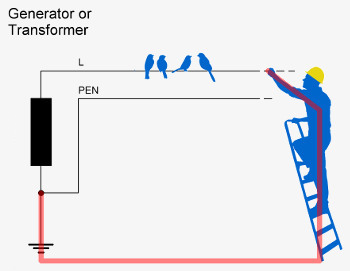
أما الإنسان الذي يلامس الخط نفسه فسيصاب بصعقة كهربائية، والسببان هما: أولاً أنه يقف على الأرض، وثانياً أن محوّل أو مولّد القدرة موصول بالأرض أيضاً. ولأن الأرض توصل الكهرباء تكون الدارة مغلقة ويمر تيار خطير في جسم الإنسان. A person however who gets in contact with the same power line will get an electric shock. This has two reasons, first the person is standing on the ground and second, the power transformer or generator as well is connected to ground. Since ground conducts electricity the circuit is closed and a dangerous current flows through the body of the person.
ووظيفة مفك الاختبار النيوني (neon tester) تقوم على المبدأ نفسه: يمر تيار (صغير جداً) من الطور عبر مصباح نيون ومقاومة عالية القيمة داخل المفك، عبر جسم الفني إلى الأرض. ولأن الحيادي موصول بالأرض أيضاً في تركيبات المنازل تُغلق الدارة ويضيء مصباح النيون عند ملامسة الطور. The function of a neon tester is based on the same principle: A (very small) current flows from line, through a neon lamp and a high ohmic resistor inside the screwdriver, through the body of the technician to ground. Because neutral is also earthed in house installations the circuit is closed and the neon lamp lights up when getting in contact with line.

نظام الأرضي TN-C-S: لأسباب السلامة يجب أن يطابق التركيب الكهربائي في المباني معايير معينة، ومنها المعيار الذي يحدد نظام الأرضي. ومن أكثر أنظمة الأرضي شيوعاً في العالم، بما فيه العالم النامي، نظام يسمى TN-C-S
The TN-C-S earthing system
For safety reasons the electrical installation in buildings has to meet certain standards. One standard specifies the earthing system. One of the most common earthing systems in the world, including the developing world, is called TN-C-S (Terre Neutre Combiné Séparé — أرضي وحيادي مدمجان منفصلان)(Terre Neutre Combiné Séparé). والخاصية الأساسية لنظام TN-C-S هي موصل PEN المدمج إلى المبنى، والفصل الصارم بين PE (الأرضي الحامي) وN (الحيادي) داخل المبنى.. The main characteristic of TN-C-S is the combined PEN connection to the building and the strict separation of PE (Protective Earth) and N (Neutral) inside the building.يوضح المخطط التالي معيار TN-C-S مع حمولة موصولة، وهي هنا عنصر تسخين. The following schematic shows the TN-C-S standard with a connected consumer, in this case a heating element.
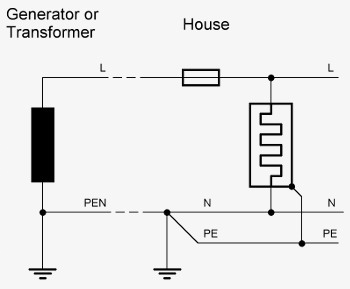
أحد جانبي المحوّل موصول بالأرض ويُمد أيضاً كموصل PEN (أرضي حامي + حيادي) إلى المنازل، والموصل الآخر هو الطور. وفي نقطة التوزيع خارج المنزل أو داخل لوحة التوزيع فيه يُفصل PEN إلى ثلاثة أسلاك — L وN وPE — تصل إلى كل مقابس الحائط ومنها عبر كبلات التغذية إلى كل جهاز موصول. One side of the transformer is earthed and is also led as PEN (protective earth and neutral) to the houses. The other conductor is line. At the distribution point outside the house or inside the distribution board in the house PEN gets separated. Three wires - L, N and PE - get now to all wall sockets and through the power cords to all connected equipment.
لكن لماذا نحتاج نظام أرضي أصلاً؟ ولماذا يُنفذ بهذه الطريقة؟ But why is a earthing system needed anyway? And why is it done in this way?
سيناريوهات العطل: إذا لامس موصل الطور في عنصر التسخين جسمه المعدني بسبب عطل، يحدث التالي: يمر تيار من الطور (L) عبر الجسم المعدني إلى الأرضي الحامي (PE) الموصول به، ولأن PE موصول بالحيادي (N) يُقصَر التيار وينفصل المصهر أو القاطع الآلي؛ فيُفصل السخّان ولم يعد الجسم المعدني تحت الجهد.
Fault scenarios
If, due to a fault, the line connection of the heating element gets in contact with the metal housing the following would happen: A current flows from line (L) over the metal housing through the connected protective earth (PE). Since PE is connected with neutral (N) the current gets short-circuited and the fuse or circuit breaker would trip. The heater gets disconnected and the metal housing is no longer live.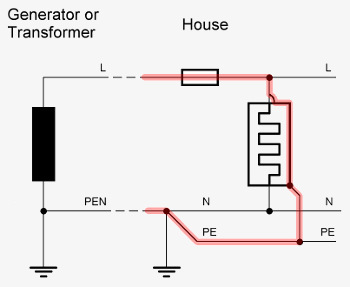
أما لو لم يُركّب PE أو قُطع اتصاله فلن ينصهر المصهر، ويبقى الجسم تحت الجهد — بنتائج قاتلة. If no PE would have been installed or the PE connection would be interrupted the fuse would not blow. The housing would be under voltage - with deadly consequences.
ولو كان القصر المفترض على الجسم في الجانب الآخر من عنصر التسخين لن يحدث شيء، لأن N وPE موصولان معاً أصلاً، فلا يوجد فرق كمون ضار. If the assumed short-circuit to the housing would be on the other side of the heating element nothing would happen because N and PE are connected together anyway. There would be no harmful potential difference.
في هذا السيناريو يقطع المصهر أو القاطع (MCB) الدارة بأمان حين يحدث قصر إلى الأرض داخل الجهاز. وينصهر المصهر أيضاً حين يرتفع التيار فجأة كثيراً عن المعتاد (مثلما يتوقف محرك) ويتجاوز تيار الفصل للمصهر أو القاطع. In this scenario the fuse or MCB interrupts the circuit safely when a short-circuit to ground happens inside the equipment. The fuse would also blow when the current suddenly is much higher than usual (e.g. a motor gets stuck) and the current exceeds the trip current of the MCB or fuse.
لكن المصهر لن يفصل إذا مر التيار في جسم إنسان لامس الطور خطأً؛ فتيار الجسم أصغر من أن يُفصل القاطع، لكنه أكبر من أن يقتل الإنسان. But the fuse would NOT trip if a current flows through the body of a person who accidently touches line. The current through the body is too little to trip the MCB - but it is big enough to kill the person.
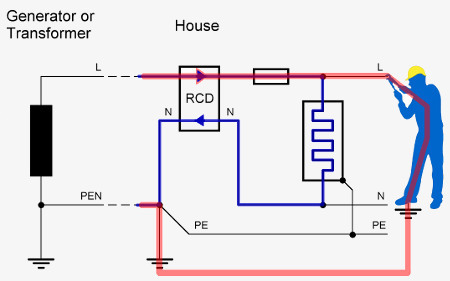
في السيناريو التالي يلامس فني عنصر تسخين خطأً. In the following scenario a technician accidently gets in contact with a heating element.
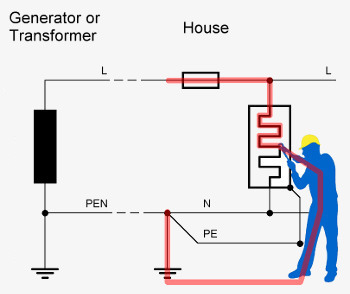
ولأن الفني يقف على الأرض يمر تيار عطل في جسمه عبر الأرض إلى PEN. وحتى إن لم يلامس الطور مباشرة (نصف جهد الشبكة في الصورة) يكون الجهد كافياً لإصابته أو قتله. والمشكلة القاتلة أن التيار عبر الجسم بضعة mA فقط ولن يُفصل المصهر. Because the technician stands on the floor a fault current flows through his body, through earth to PEN. Even if the technician does not touch line directly (half mains voltage in the image), the voltage is high enough to injure or kill him. The fatal problem is, that the current through the body is only a few mA and will not trigger the fuse.
القاطع الآلي أو المصهر لا يمكنه كشف تيارات العطل الصغيرة، ومن ثم لا يستطيع حماية الناس من الصعقات؛ أما قاطع التيار المتبقي (RCD) فيستطيع. A MCB or fuse can not detect small fault currents and thus can not protect people from electric shocks. But a RCD can.
قاطع التيار المتبقي (RCD): قاطع التيار المتبقي (RCD) أو قاطع عطل الأرضي (GFI) جهاز سلامة يحمي البشر من الصعقة الكهربائية؛ فهو يكشف تيارات العطل ويفصل كل الأحمال فوراً عن جهد التغذية. لكنه لا يحمي الأجهزة الموصولة من الحمل الزائد أو الحرائق أو الأضرار الأخرى، فالمناهير أو القواطع الآلية (MCB) لا تزال لازمة.
Residual-Current Device (RCD)
The residual-current device (RCD) or ground fault interrupter (GFI) is a safety device which protects humans against electric shock. The RCD detects fault currents and disconnects all consumers instantly from the supply voltage. The RCD does not protect connected equipment from overload, fire and other damage. Fuses or circuit breakers (MCB) are still needed.يوجد RCD في لوحة التوزيع مباشرة بعد القاطع الرئيسي وقبل القواطع أو المناهير. The RCD is found in the distribution board directly after the main circuit breaker and before the MCBs or fuses.
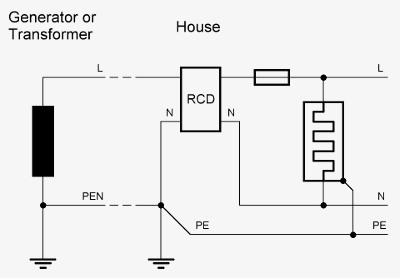
في الظروف الطبيعية يكون تيار الطور (L) مساوياً لتيار الحيادي (N) (التيار الداخل إلى الحمل = التيار الخارج منه)، وفي حالة عطل — كأن يلامس أحدهم الطور — يعود جزء من التيار عبر الأرض وPE، أي إن جزءاً من تيار العودة يتجاوز RCD. ويصبح تيار N مختلفاً عن تيار L، فيكشف RCD عدم توازن النسبة هذه ويحرّك ملامساً مدمجاً فيه فتُفصل كل الأحمال. Under normal circumstances line current (L) and neutral current (N) are identical (current into the load = current out of the load). In case of a failure, e.g. someone gets in contact with line, a part of the current flows back through earth and PE. This means that a part of the returning current is bypassing the RCB. N current and L current are now different. The RCD detects this unbalanced current ratio, trips a build-in contactor and all consumers get disconnected.
تقنية RCD بسيطة لكنها دقيقة؛ فله طرفان دخلان (L و N) وطرفان خرجان (L و N)، ويمر كل من L وN عبر ملامسات المرحّل ثم يُوصلان بلفّتين على قلب حلقي (toroidal). وفي لفّة ثالثة يتولد جهد عند نشوء مجال مغناطيسي، وهذا الجهد يتحكم بالمرحّل الذي يقطع جهد التغذية. The technology inside a RCD is simple but tricky. The RCD has two input terminals (L and N) and two output terminals (L and N). Both, L and N pass the relay contacts and are then connected to coils on a toroidal core. In a third coil a voltage is generated when a magnetic field comes into being. This voltage controls the relay which then interrupts the supply voltage.
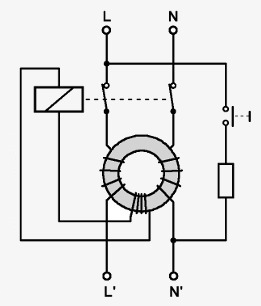 عادةً لا يحدث ذلك لأن لفّة L ولفّة N متماثلتان لكن إحداهما معكوسة؛ فكلتاهما تُنشئ مجالاً مغناطيسياً عند مرور تيار، لكن بسبب إزاحة الطور 180 درجة يكون الجهد الناتج في اللفّة الثالثة 0 V فلا يُنشَّط المرحّل.
Usually this does not happen because L coil and N coil are identical but one of them is inverted. Both create a magnetic field when a current flows.
But due to the 180 degree phase shift the resulting voltage received in the third coil is 0 V. The relay is not activated.
فقط إذا اختلف التيار عبر L وN يتولد جهد يحرّك المرحّل ويفتح الملامسات. ولا يمكن أن يحدث تيار عطل كهذا إلا إذا كان جزء من التيار الداخل إلى الحمل لا يعود عبر RCD بل يتجاوزه عبر PE. Only if the current through L and N is different a voltage is created which trips the relay and opens the contacts. Such a fault current can only happen when a part of the current which goes into a load does not go back through the RCD but is by-passed through PE.
زر الضغط والمقاومة في المخطط يمثلان وظيفة الاختبار: عند ضغط الزر يتولد تيار عطل يتجاوز القلب الحلقي، فيجب أن يتحرر المرحّل. The push button and the resistor in the circuit diagram build a test function. When the button is pressed a fault current is created which bypasses the toroidal core. The relay has to release.
معظم قواطع RCD تفصل عند تيار تشغيل 30 mA، وكل ما هو أعلى من ذلك يُصنّف تياراً متبقياً أو عطلاً. وقواطع 30 mA قياسية لتركيبات المنازل ولمعظم مرافق المستشفى، وتتوفر أيضاً قواطع طبية خاصة تفصل عند تيارات أقل مثل 10 mA. Most of the RCDs trip at a trigger current of 30 mA. Everything higher than this is classified as residual or fault current. 30 mA RCDs are standard for house installation and for most facilities in the hospital. Special medical grade RCDs are also available. They trip already at lower currents e.g. at 10 mA.
وللتركيبات ثلاثية الطور تتوفر قواطع RCD ثلاثية الطور؛ فإلى جانب N تمر الأطوار الثلاثة (L1 - L3) كلها عبر القاطع. For 3-phase installation also 3-phase RCDs are available. Beside N all three lines (L1 - L3) go through the RCD.
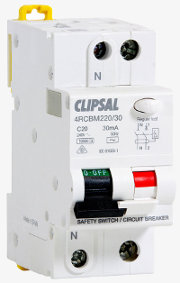
 لاحظ زر الاختبار الأبيض؛ فهو ليس آلية تحرير ميكانيكية بل اختبار حقيقي يتولد فيه تيار عطل.Note the white test push button. It is not a mechanical release mechanism but a real test where a fault current is created.
روابط ومصادر
Links and sources
Wikipedia: Residual-current_device (RCD)
Wikipedia: Earthing system
Wikipedia: Ground (electricity)
Wikipedia: Test light
Electrical wiring in the UK