نظرة عامة على محاكي حاسوب التخفيف الحراري
في الممارسة السريرية يُقدَّر Cardiac Output بطريقة التخفيف الحراري (thermodilution). يُدخل قسطرة (catheter) في الشريان الرئوي، وفي طرفها ثرمستور (thermistor) يقيس درجة حرارة الدم. ويُدخل ثرمستور ثانٍ في كيس المحلول الملحي (saline) — وهو السائل المحقون (injectate) — لقياس درجة حرارته.
يكون السائل المحقون عادةً بدرجة حرارة الغرفة أو محلولاً ملحياً مثلجاً (0 °C). وعلى حاسوب Cardiac Output يُدخل المستخدم «ثابتاً» (constant): رقم يحدده المصنّع ويخبر الحاسوب بدرجة حرارة السائل المحقون وحجمه خلال فترة زمنية محددة، ويقرأه المستخدم من جدول يوفره المصنّع. الحجم النموذجي 10 ml، والزمن النموذجي 3 ثوانٍ.
يضغط المستخدم زر «بدء القياس»، ويحقن السائل بالمحقنة (syringe) عبر القسطرة إلى شريان المريض. يقيس الثرمستور الموجود في طرف القسطرة فرق درجة الحرارة بين الدم والمحلول مع الزمن، ثم يجري حساباً يقدّر Cardiac Output. والقيمة الطبيعية تتراوح عادةً بين 3 و8 لترات في الدقيقة. ولأن العملية تعتمد كثيراً على مهارة التنفيذ، تُجرى ثلاثة قياسات للحصول على متوسط موثوق.
ويُقاس Cardiac Output بإدخال قسطرة ذات ثرمستور في طرفها عبر البطين الأيمن إلى الشريان الرئوي، وحقن محلول ملحي بارد في القسطرة، ثم تكامل منحنى درجة الحرارة الناتج في الشريان الرئوي.
النص الإنجليزي الأصلي
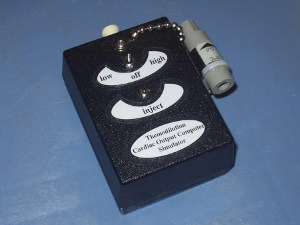
Barry designed and build a Cardiac Output Computer Simulator some years ago. It works well, is cheap and not too difficult to build.
Here his instructions:
|
Do-it-yourself
Cardiac Output Computer Simulator
created by Barry Voss
|
Overview of the Thermodilution Cardiac Output Computer Simulator
In clinical practice cardiac output can be estimated with the thermodilution method. A catheter is inserted
into the pulmonary artery. The catheter has a thermistor in the tip measuring the temperature of the blood.
A second thermistor is inserted into a bag of saline to measure its temperature (the saline is the injectate).
The injectate is typically room temperature or iced saline (0 degrees centigrade). On the cardiac output
computer the user enters a 'constant'. This is a number determined by the manufacturer that tells the
computer the temperature of the injectate, and the volume of the injectate over a prescribed period of
time. The constant is a number that the user looks up on a chart provided by the manufacturer. A typical
injectate volume would be 10 ml, and a typical time would be 3 seconds. The user presses a 'start
measurement' button on the computer and delivers the injectate via syringe into the catheter and thus into
the artery of the patient. The thermistor at the tip of the catheter measures the temperature differential of
the blood/saline over time and performs a calculation estimating the cardiac output. Cardiac output
typically run in the 3 to 8 liters per minute range. This process is very technique dependant so three
measurements are done to get a good average.
Cardiac output is measured by placing a catheter with a thermistor on the tip through the right
ventricle into the pulmonary artery, injecting cold saline into the catheter, and integrating the
resulting pulmonary artery temperature profile...
Read his whole article.
Questions and remarks please directly to Barry.
Thanks Barry!